Freestanding car awnings have quickly become one of the most practical upgrades for modern camping, overlanding, and 4WD travel. But what makes a freestanding awning different from a traditional vehicle awning? And is a 270-degree car awning really worth the extra size and weight?
For campers who spend more time outdoors, the answer often comes down to one simple thing: how quickly you can create a large, usable shelter without filling your campsite with poles and ropes.
A well-designed freestanding car awning can turn the side and rear of an SUV, pickup truck, van, or 4WD into a shaded outdoor living area within seconds or minutes. Depending on the design, modern 270 degree awnings can provide roughly 8–12+ square meters of coverage, while premium systems can also integrate LED lighting, wall kits, wind-management systems, and modular accessories.
The market is also moving toward more sophisticated designs. Established outdoor brands such as Rhino-Rack, The Bush Company, DARCHE, and 23ZERO are now offering freestanding 180° and 270° systems with reinforced aluminium arms, polycotton canvas, integrated lighting, and optional wall systems.
So, what are the real advantages of a freestanding car awning?
Let’s take a closer look.
What Is a Freestanding Car Awning?
A freestanding car awning is a vehicle-mounted shelter designed to support most or all of its deployed structure without relying on vertical ground poles during normal use.
Unlike a conventional straight awning, where two or more legs commonly need to be extended to the ground, a freestanding design uses a combination of:
- Reinforced aluminium arms
- Hinges and pivot points
- Truss or box-section structures
- Tensioned awning fabric
- Vehicle-mounted brackets
to support the deployed canopy.
This allows campers to create an outdoor living area without putting multiple poles into the ground.
However, freestanding does not mean “windproof.”
Manufacturers generally recommend adding guy ropes, pegs, or deployable legs when weather conditions become more challenging. For example, The Bush Company specifies that its 270 XT MAX can handle gusts up to 50 km/h when correctly pegged and guyed, while DARCHE rates its Eclipse 270 Freestanding Awning to 30 km/h while freestanding based on its own wind testing.
That distinction is important when evaluating a freestanding 270 awning.
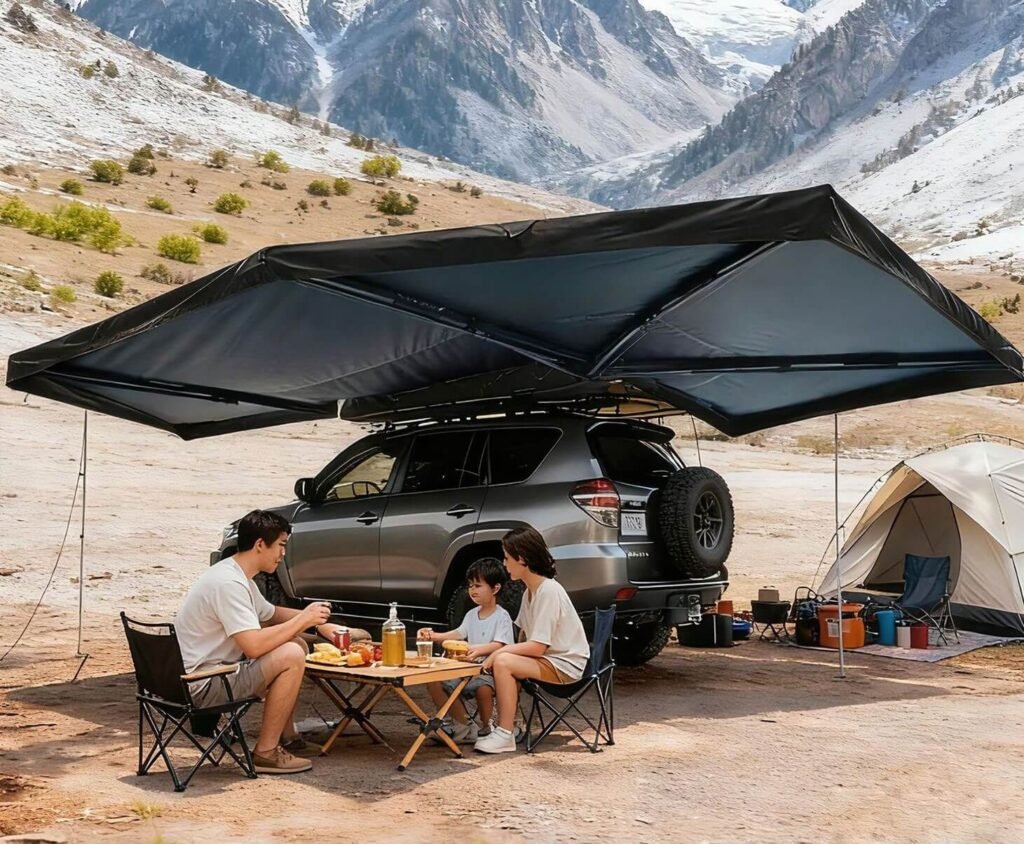
Why Are 270 Degree Car Awnings So Popular?
Among modern vehicle awnings, the 270 degree awning has become one of the most interesting designs for overlanding and 4WD camping.
A conventional side awning generally covers one side of the vehicle.
A 180° awning extends further around the vehicle.
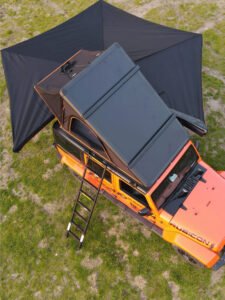
A 270° car awning goes one step further, wrapping from the side toward the rear of the vehicle.
This creates a much larger continuous shelter.
For example:
| Awning Type | Typical Coverage Concept | Best For |
|---|---|---|
| Straight / 180° | Side-focused coverage | Solo campers, SUVs, compact setups |
| 180° Freestanding | Wider side/rear coverage | Couples, weekend camping |
| 270° Freestanding | Side + rear wraparound | Overlanding, families, 4WD touring |
| 270° Large-Format | Maximum living area | Families, long-distance touring, large vehicles |
Current products demonstrate how much this category has evolved.
Rhino-Rack’s Batwing 180 Freestanding provides 8.4 m² of coverage, while its newer Batwing 270 Freestanding provides 12.3 m². The Bush Company’s 270 XT Mk2 offers 8 m², while the larger 270 XT MAX Mk2 reaches about 12 m². DARCHE’s Eclipse 270 Freestanding provides 11.5 m², and 23ZERO’s Peregrine PRO 5-arm 270 covers approximately 117 ft², or about 10.9 m².
This means the current premium market broadly clusters around 8–12+ m² of usable shade, depending on vehicle size and arm configuration.
1. Faster Setup: Less Time Building Your Campsite
One of the biggest advantages of a freestanding car awning is simply setup speed.
Traditional camping shelters often require several steps:
- Unroll the fabric
- Extend support poles
- Adjust the legs
- Hammer in pegs
- Attach guy ropes
- Re-tension the canopy
A well-designed freestanding awning reduces much of this work.
This matters particularly during:
- Short lunch stops
- Beach trips
- Fishing
- Road trips
- Overlanding
- Sudden rain showers
- Hot summer afternoons
For campers who frequently move between locations, setup time is not a small detail. It directly affects how practical the equipment is in everyday use.
2. More Usable Space Without Filling the Ground With Poles
The biggest functional advantage of a freestanding design is that it keeps the area below the awning relatively clear.
Imagine a campsite with:
- A camping table
- Chairs
- Portable kitchen
- Cooler
- Storage boxes
- Recovery equipment
- Camping fridge
- Children’s gear
- Dogs
Traditional support legs can interfere with where these items can be placed.
A freestanding car awning moves much of the structural support into the vehicle-mounted frame and overhead arms.
This creates a cleaner living area.
That is particularly useful with 270 degree awnings, because the shelter extends around the side and rear of the vehicle.
For vehicles equipped with a rear kitchen, tailgate, drawer system, or canopy, this can be a major advantage.
3. Excellent Coverage for Outdoor Kitchens
Modern vehicle camping is increasingly about creating a functional mobile basecamp rather than simply sleeping outdoors.
Many 4WD and overlanding vehicles now have:
- Drawer kitchens
- Fridges
- Portable stoves
- Rear tailgates
- Canopy kitchens
- Water systems
- Recovery gear
This is exactly where 270 degree vehicle awnings become especially useful.
Because the canopy extends around the rear of the vehicle, you can place your cooking and food-preparation area directly under the shelter.
It can protect:
Your food from sun → your kitchen from rain → your equipment from weather → your family from heat.
This is one reason 270° awnings are particularly popular among long-distance touring and overlanding users.
4. Better Shade Coverage Than a Traditional Side Awning
Coverage area is one of the easiest specifications to compare.
Consider a few current products:
| Representative Model | Design | Coverage | Weight |
|---|---|---|---|
| Rhino-Rack Batwing 180 Freestanding | 180° | 8.4 m² | 24.7–25 kg |
| Rhino-Rack Batwing 270 Freestanding | 270° | 12.3 m² | 31.7 kg |
| The Bush Company 270 XT Mk2 | 270° | 8 m² | 27.8 kg |
| The Bush Company 270 XT MAX Mk2 | 270° | 12.2 m² | 33.5 kg |
| DARCHE Eclipse 270 Freestanding | 270° | 11.5 m² | Market varies by configuration |
| 23ZERO Peregrine PRO 5 Arm | 270° | ~10.9 m² | 23.1 kg |
Source: manufacturer specifications.
The exact specifications naturally vary by version, mounting hardware, and market.
But the larger trend is obvious:
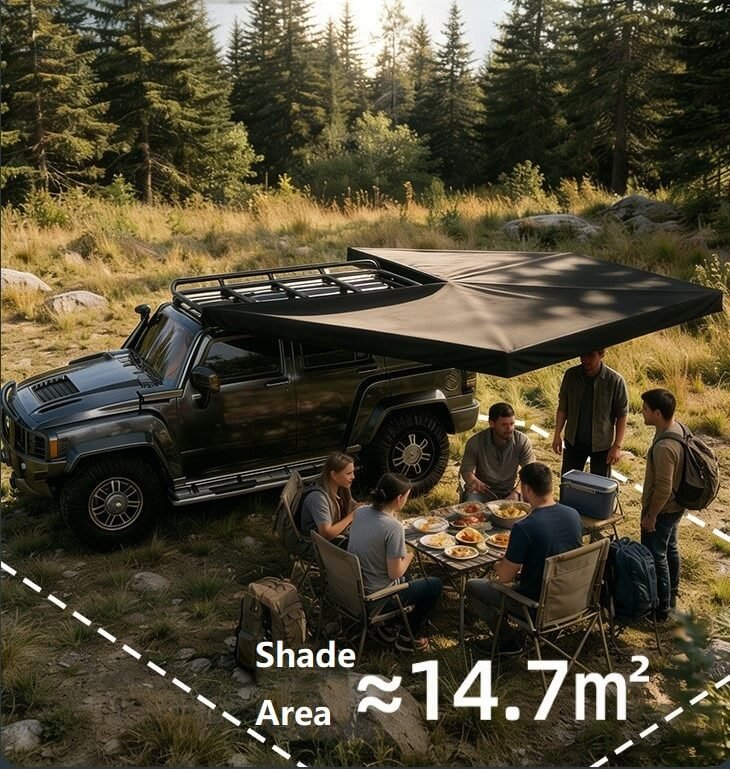
Modern premium vehicle awnings are increasingly designed around 8–12+ m² of shelter rather than simply providing a small strip of shade.
That extra area is enough for much more than one or two chairs.
A properly positioned 270° awning can potentially cover:
- A dining table
- 4–6 camping chairs
- Outdoor kitchen equipment
- Portable fridge
- Storage boxes
- Camping lights
- Pet space
- Children’s activity area
This makes the awning a genuine outdoor living extension of the vehicle.
5. Better Protection From Sun, Rain and Heat
Shade is not just about comfort.
For outdoor campers, a vehicle awning can reduce direct solar exposure and help create a cooler environment underneath the canopy.
The material and coating system matter significantly.
Current premium awnings commonly use ripstop polycotton canvas or similar technical fabrics.
For example:
- Rhino-Rack uses 280gsm ripstop polycotton on its freestanding Batwing products.
- The Bush Company uses approximately 310–315gsm ripstop polycotton canvas on its 270 systems.
- DARCHE uses 320gsm ripstop polycotton on its Eclipse 270 range.
- 23ZERO combines technical fabric with its Light Suppression Technology on Peregrine products.
Water resistance also varies.
Rhino-Rack lists a 2000 mm waterhead rating for its 270 and 180 freestanding Batwing models, while DARCHE’s Eclipse 270 G2 lists a 1500 mm water rating with seam sealing.
Therefore, when evaluating a 4WD awning, shoppers should not look at fabric weight alone.
A better checklist includes:
Fabric weight + waterproofing + seam construction + UV performance + frame strength + drainage design.
6. Freestanding Does Not Mean You Should Ignore Wind
This is one of the most important technical points.
A common misunderstanding is:
“If an awning is freestanding, I don’t need to worry about wind.”
That is incorrect.
An awning is effectively a large flexible surface connected to a vehicle-mounted structure. Strong wind can create substantial forces on both the fabric and frame.
The important question is therefore not:
“Is it freestanding?”
The better question is:
“Under what wind conditions is it freestanding, and under what conditions does it require additional anchoring?”
The takeaway is simple:
Freestanding convenience and wind resistance are two different engineering characteristics.
A high-quality awning should provide clear guidance on:
- Freestanding wind limits
- Guy rope requirements
- Ground anchoring
- Leg deployment
- Water pooling
- Severe weather storage
- Snow loading
Responsible manufacturers should communicate these limits clearly rather than making vague claims such as “extreme wind resistant.”
7. Fewer Ground Obstacles Make Campsites Safer and More Comfortable
Anyone who has camped at night knows how easy it is to trip over:
- Tent poles
- Guy ropes
- Awning legs
- Cooler boxes
- Camping chairs
A freestanding structure can significantly reduce ground clutter during normal conditions.
This is especially valuable at night when the campsite is illuminated only by small camping lights.
It also helps when several people are moving around the vehicle.
For families with children or campers who frequently use the rear kitchen, keeping the central area open can improve the overall camping experience.
However, guy ropes and ground anchors should still be used when conditions require them.
8. A 270° Awning Can Become a Modular Outdoor Room
One of the most interesting developments in the vehicle awning market is the move from simple shade products toward modular shelter systems.
A basic awning gives you:
Shade
Add side walls and you can create:
Wind protection
Add more wall panels and you can create:
Privacy
Add flooring or a compatible enclosure and the space starts functioning more like:
An outdoor room
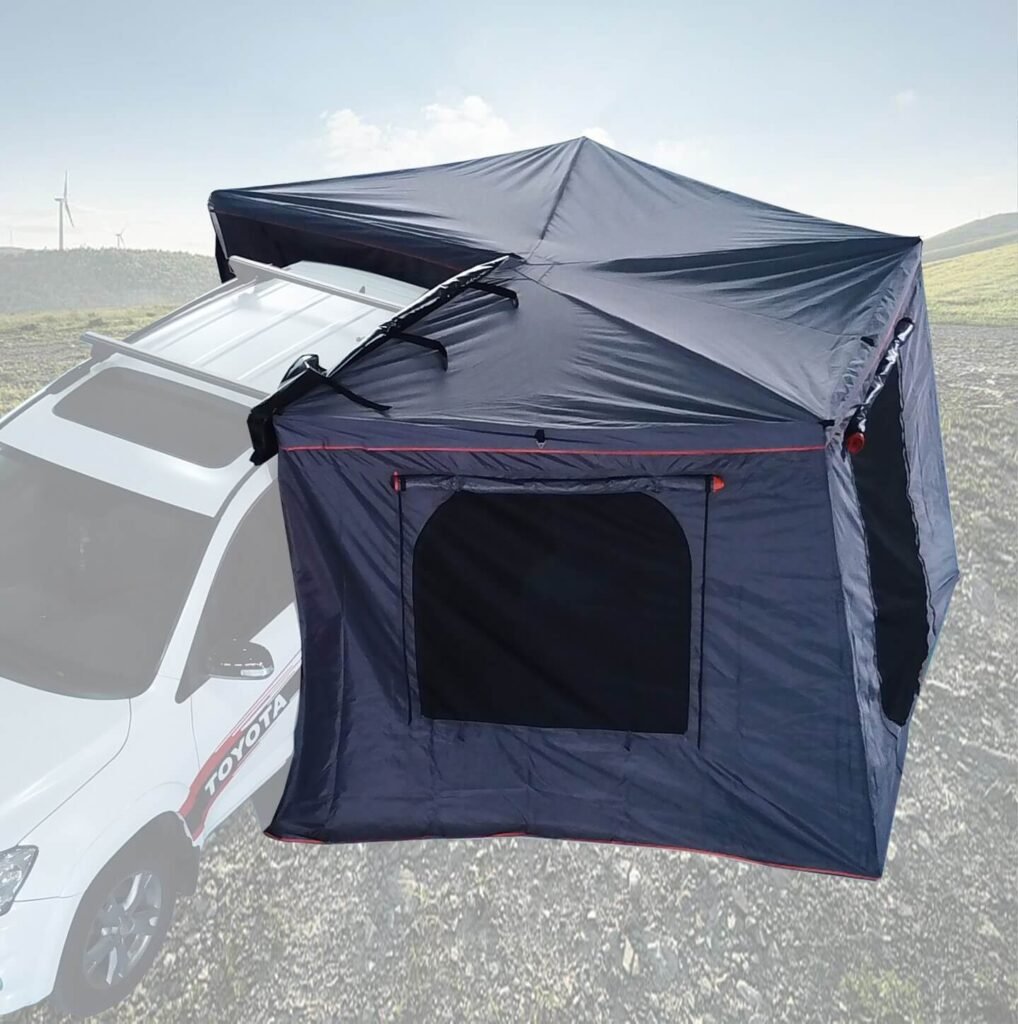
This modular design philosophy is important for brands developing the next generation of 4WD camping accessories.
Customers increasingly want one platform that can be upgraded over time instead of buying several completely separate shelters.
9. Integrated LED Lighting Adds Real Value
Another trend in premium freestanding car awnings is integrated lighting.
Instead of carrying a separate lantern and trying to position it correctly, integrated LED systems can illuminate the entire shelter.
This is particularly useful for:
- Cooking after sunset
- Family dinners
- Setting up camp at night
- Night-time vehicle loading
- Fishing
- Emergency situations
For customers building an integrated overlanding setup, features such as LED lighting, accessory channels and wall compatibility can make a significant difference.
10. Freestanding Awnings Are Ideal for Overlanding and Road Trips
The United States remains a large market for vehicle-accessible outdoor recreation.
According to the Outdoor Industry Association’s 2026 Camping Report, 42.3 million Americans camped close to their vehicles in 2025, an increase of more than 5% in one year and 6.2 million participants since 2020. The report also notes that 93% of campers participate in other outdoor activities such as hiking, fishing, or birding.
This type of camping environment is particularly suitable for vehicle-mounted shelters because the vehicle itself becomes the center of the camping system.
A typical overlanding setup might include:
Roof rack → rooftop tent → 270° awning → outdoor kitchen → fridge → storage → lighting → recovery gear
The awning therefore becomes more than an accessory.
It becomes part of the overall vehicle camping architecture.
180° vs 270° Freestanding Awning: Which One Should You Choose?
Not every camper needs the largest possible awning.
A 180° freestanding awning can make more sense for smaller vehicles, couples, or users who primarily need side coverage.
A 270° model becomes more attractive when the user needs:
- Rear kitchen coverage
- More seating space
- Larger family shelter
- Better protection around the rear of the vehicle
- Compatibility with overlanding accessories
- Additional wall systems
The trade-off is simple:
More coverage usually means more weight, larger packed dimensions and greater structural loads.
Therefore, “bigger” does not automatically mean “better.”
The correct question is:
How much shelter do you actually need, and how much weight can your vehicle safely carry?
What Should You Look for When Buying a Freestanding Car Awning?
For consumers, distributors, and outdoor brands, the following specifications are more useful than simply looking at the awning’s appearance.
1. Vehicle Compatibility
Check:
- Roof-rack compatibility
- Mounting bracket type
- Required rack length
- Left/right mounting configuration
- Dynamic roof load
- Static roof load
- Clearance around doors and tailgates
2. Awning Weight
Weight becomes increasingly important for roof-mounted camping products.
Representative premium 270 awnings currently range from roughly 23–34 kg before or depending on mounting hardware/configuration.
A lightweight awning can be attractive for:
- SUVs
- Smaller 4WDs
- Daily drivers
- Crossovers
- Long-distance touring
Heavy-duty products may offer larger coverage and stronger structures, but the vehicle’s roof system must be capable of handling the load.
3. Fabric
Look for:
- Ripstop construction
- Appropriate GSM
- UV resistance
- Water resistance
- Mould resistance
- Tear resistance
- Seam reinforcement
Higher GSM does not automatically mean better performance.
Good design requires a balance between:
Strength + weight + flexibility + packability + weather resistance.
4. Frame and Hinge Construction
This is arguably one of the most important areas of a freestanding awning.
Inspect:
- Aluminium arm profile
- Box-truss construction
- Hinge material
- Hinge thickness
- Reinforcement around pivot points
- Bracket design
- Connection points between fabric and frame
The frame is effectively the skeleton of the entire awning.
The Main Trade-Off: Coverage vs Weight
A useful way to compare modern vehicle awnings is by considering shade coverage per kilogram.
For example:
- Rhino-Rack 180 Freestanding: approximately 8.4 m² / 24.7–25 kg
- Rhino-Rack 270 Freestanding: approximately 12.3 m² / 31.7 kg
- Bush Company 270 XT: 8 m² / 27.8 kg
- Bush Company 270 XT MAX: approximately 12.2 m² / 33.5 kg
Based on those manufacturer figures, larger 270° systems can provide substantially more shelter, but the extra structure can also add roughly 5–6+ kg compared with smaller designs.
That leads to an important product-development principle:
The goal should not be to build the biggest awning possible. The goal should be to achieve the best balance of coverage, structural strength, weight and ease of use.
Why Freestanding Car Awnings Are Becoming More Important
The broader camping market is becoming increasingly vehicle-oriented.
According to the Outdoor Industry Association, vehicle-accessible camping in the U.S. reached 42.3 million participants in 2025.
At the product level, manufacturers are responding with increasingly integrated systems:
Vehicle → Roof Rack → Rooftop Tent → Freestanding Awning → Wall Kit → Lighting → Outdoor Kitchen
This means a freestanding car awning is no longer simply a piece of shade fabric.
It can function as:
- A sun shelter
- Rain shelter
- Outdoor dining area
- Kitchen cover
- Gear storage area
- Vehicle-side lounge
- Privacy area
- Overlanding basecamp
And the growing popularity of 270 degree awnings reflects this broader change from basic camping equipment toward integrated outdoor living systems.
FAQs About Freestanding Car Awnings
Are freestanding car awnings really freestanding?
Yes, many modern freestanding awnings are designed to support themselves from the vehicle-mounted structure during normal conditions without ground poles.
However, freestanding does not mean that no anchoring is ever necessary. Guy ropes, pegs or additional legs should be used according to weather conditions and the manufacturer’s instructions.
Is a 270 degree awning better than a 180 degree awning?
Not necessarily.
A 270° awning generally provides more coverage and better rear-vehicle protection, making it attractive for families, 4WD touring and overlanding.
A 180° awning can be better for smaller vehicles, lighter setups and campers who mainly need side coverage.
How much does a 270 degree car awning weigh?
Current premium products vary considerably, but representative models range from approximately 23 kg to 34 kg, depending on size, arm configuration, fabric, frame and mounting hardware.
Always check the exact model’s weight and your vehicle’s roof/rack load limits.
How much coverage does a 270 awning provide?
Current products commonly offer approximately 8–12+ m² of coverage.
Examples include 8 m² for the Bush Company 270 XT, 11.5 m² for the DARCHE Eclipse 270 Freestanding, and around 12.2–12.3 m² for larger Bush Company and Rhino-Rack 270 models.
Can you leave a freestanding awning open in strong wind?
You should not assume that you can.
Freestanding wind limits vary by design. DARCHE lists 30 km/h for its Eclipse 270 while freestanding, while The Bush Company specifies higher gust resistance for its 270 XT MAX when properly pegged and guyed.
Always follow the manufacturer’s wind and severe-weather instructions.
Can a 270 awning be used with a rooftop tent?
Yes. Many vehicle awning systems are designed to work alongside rooftop tents, although compatibility depends on mounting position, rack length, vehicle height and the location of the rooftop tent ladder.
Some manufacturers also offer dedicated entry or wall solutions designed around rooftop-tent setups.
Can I add walls to a freestanding awning?
Many modern systems support optional wall kits.
Walls can provide:
- Wind protection
- Rain protection
- Privacy
- Cooler shade
- Insect protection
- Additional sleeping or living space
This modular design is becoming an important feature in the premium overlanding awning market.
What is the best material for a 4WD awning?
There is no single best material for every application.
Ripstop polycotton canvas is popular in premium 4WD and overlanding awnings because it can combine durability, UV performance, breathability and weather resistance.
The final performance depends on the complete system, including fabric treatment, seams, frame and drainage design.
Is a freestanding awning suitable for daily driving?
It can be, but the packed size, weight and aerodynamic profile should be considered.
For daily-driven SUVs and smaller vehicles, a compact 180° or smaller awning may be more practical.
For larger 4WDs, pickups and overlanding vehicles, a 270° awning can offer significantly more usable space.
Is a 270 degree awning worth the extra weight?
For campers who frequently use outdoor kitchens, rear vehicle storage, family seating or extended overlanding setups, the additional coverage can be very valuable.
For someone who only needs a small shaded area for occasional day trips, a lighter straight or 180° awning may be the more efficient choice.
Final Thoughts: Is a Freestanding Car Awning Worth It?
For modern vehicle-based camping, a freestanding car awning offers one of the best combinations of convenience, coverage and flexibility.
The major advantages are clear:
Fast setup.
Large usable shelter.
Less ground clutter.
Better rear-vehicle coverage.
Excellent compatibility with outdoor kitchens.
Modular wall options.
Integrated lighting on some premium models.
Strong potential for overlanding and long-distance touring.
The growing adoption of 270 degree car awnings is particularly significant because the design turns unused space around the vehicle into a practical outdoor living area.
But choosing the right awning is not simply about finding the largest coverage number.
The best product balances:
Coverage + weight + frame strength + weather resistance + wind performance + vehicle compatibility + ease of deployment.
For weekend campers, a compact 180° freestanding awning may be the smarter solution.
For families, 4WD enthusiasts and serious overlanders, a freestanding 270 awning can transform the vehicle into a much more comfortable mobile basecamp.
The future of vehicle camping is not simply about adding more equipment.
It is about making the vehicle itself a smarter, faster and more comfortable camping system.
Looking for a Freestanding Car Awning for Your Vehicle?
Explore our 270° vehicle awnings, freestanding car awnings and modular outdoor shelter solutions designed for SUVs, 4WDs, pickups, vans and overlanding applications.
Contact our team for OEM/ODM vehicle awning solutions, product specifications, sampling and custom development.