Rooftop tents have become increasingly popular among overlanders, campers, and outdoor enthusiasts because they provide a comfortable sleeping platform without requiring a traditional ground tent setup.
But one question often comes up before buying one:
How much wind can a rooftop tent actually handle?
The answer is more complicated than simply giving one number such as “50 mph” or “60 mph.”
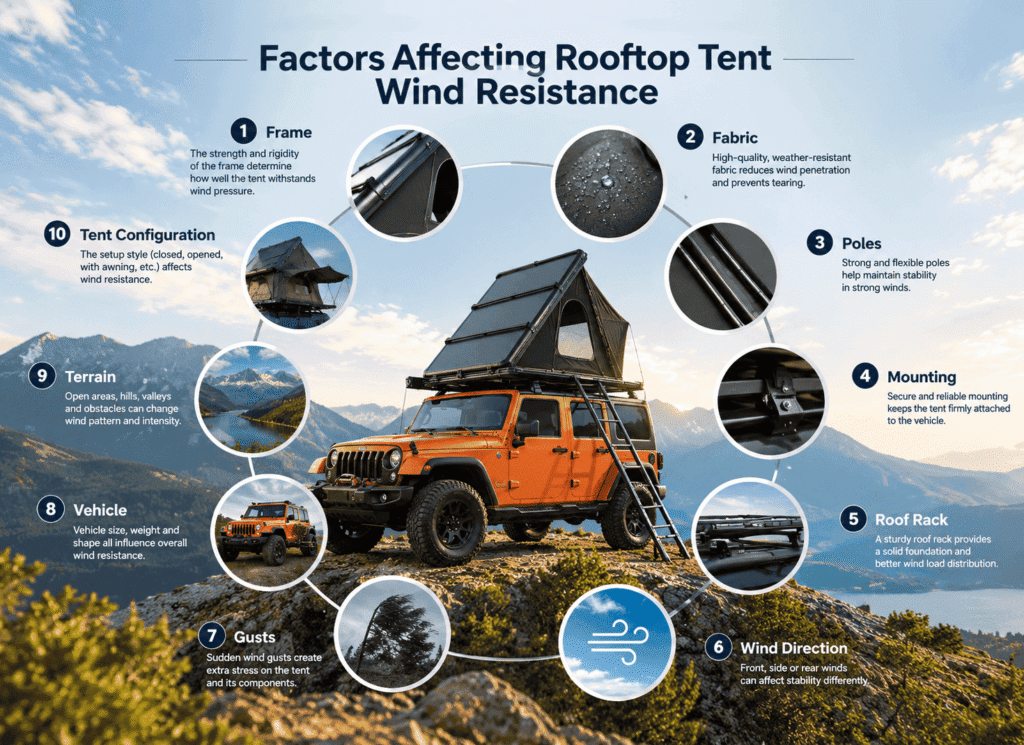
A rooftop tent’s ability to withstand wind depends on several factors, including its structural design, fabric, poles, mounting system, vehicle position, wind direction, sustained wind speed, and especially sudden gusts.
For example, according to the U.S. National Weather Service, winds of 32–38 mph (52–61 km/h) are classified as Beaufort Force 7, while 39–46 mph (63–74 km/h) are classified as Force 8 or gale-force winds. At 47–54 mph (76–87 km/h), conditions reach Force 9, where minor structural damage can occur to some structures.
This is why a responsible rooftop tent manufacturer should avoid treating a single wind-speed number as a universal safety limit.
Instead, it is better to understand how wind affects a rooftop tent and what factors determine its real-world wind resistance.
Quick Answer: How Much Wind Can a Rooftop Tent Handle?
There is no universal wind-speed rating that applies to every rooftop tent.
A properly designed and securely mounted rooftop tent can handle normal windy camping conditions, but performance varies considerably between models.
As a practical reference:
| Wind Speed | Beaufort Force | Typical Outdoor Conditions | Rooftop Tent Consideration |
|---|---|---|---|
| 13–18 mph / 21–29 km/h | 4 | Moderate breeze | Generally manageable for a properly installed tent |
| 19–24 mph / 31–39 km/h | 5 | Fresh breeze | Wind movement becomes noticeable |
| 25–31 mph / 40–50 km/h | 6 | Strong breeze | Check poles, fabric and mounting carefully |
| 32–38 mph / 52–61 km/h | 7 | Near gale | Consider reducing exposure and monitoring conditions |
| 39–46 mph / 63–74 km/h | 8 | Gale | Strong winds; camping conditions become increasingly challenging |
| 47–54 mph / 76–87 km/h | 9 | Strong gale | Severe conditions; seek a safer location |
| 55+ mph / 89+ km/h | 10+ | Storm conditions | Rooftop tent use should not be treated as normal camping |
These ranges are based on the NOAA/National Weather Service Beaufort wind scale and are not a certification or universal wind rating for rooftop tents.
The most important point is:
A rooftop tent should be evaluated based on its complete structural system, not simply a headline wind-speed number.
Why Is Wind Resistance Important for a Rooftop Tent?
Unlike a conventional ground tent, a rooftop tent is mounted several feet above the ground.
That creates some advantages, such as better ventilation, reduced contact with wet ground, and improved views.
However, the elevated position can also expose the tent to stronger and more variable airflow.
Wind can affect several components simultaneously:
- Tent fabric
- Poles and hinges
- Roof or shell
- Ladder
- Mounting brackets
- Roof rack
- Vehicle attachment points
- Seams and zippers
- Windows and doors
A strong gust can also create a sudden change in loading that is very different from a steady breeze.
This is why wind gust resistance can be just as important as average wind speed.

7 Factors That Determine Rooftop Tent Wind Resistance
1. Rooftop Tent Structural Design
The first factor is the overall structure.
A well-designed rooftop tent should distribute wind loads across multiple structural components rather than concentrating the force on one point.
Important design elements include:
- Frame geometry
- Pole diameter
- Pole material
- Hinge construction
- Shell construction
- Reinforced attachment points
- Ladder connection
- Roof-rack mounting system
For example, a hard-shell rooftop tent generally has a different aerodynamic profile from a soft-shell rooftop tent.
A low-profile hard-shell design can reduce exposed surface area when driving and may also present less area directly to the wind when closed.
However, hard shell does not automatically mean better wind resistance.
The complete design still matters.
2. Rooftop Tent Fabric
The fabric is another critical component.
Common rooftop tent fabrics include:
- Polyester
- Poly-cotton
- Cotton canvas
- Ripstop fabrics
- Laminated technical fabrics
For modern rooftop tents, polyester is widely used because it can provide a useful balance between:
- Weight
- Water resistance
- UV resistance
- Tear resistance
- Drying speed
- Durability
However, fabric strength alone does not determine wind resistance.
A strong fabric can still experience problems if:
- Seams are weak
- Stitching is inadequate
- Reinforcement points are poorly designed
- Windows are too large
- Zippers are exposed
- Fabric tension is poorly controlled
Therefore, when evaluating a rooftop tent, look beyond the fabric specification.
3. Pole and Frame Strength
The supporting poles are responsible for maintaining the tent’s shape under wind pressure.
Depending on the design, manufacturers may use:
- Aluminum poles
- Steel components
- Fiberglass poles
- Gas-assisted mechanisms
- Aluminum alloy frames
The important question is not simply:
“What material are the poles made from?”
Instead, ask:
“How does the entire frame behave under repeated wind loading?”
A strong frame should maintain its geometry without excessive deformation.
This is particularly important during gusty weather because repeated loading can put stress on joints, hinges and attachment points.
4. Mounting System and Roof Rack
Even if the tent itself is strong, the mounting system can become the weak point.
A rooftop tent is only as secure as the connection between:
Tent → Mounting brackets → Roof rack → Vehicle
A high-quality mounting system should provide:
- Secure mechanical attachment
- Correct load distribution
- Appropriate hardware
- Proper tightening
- Compatibility with the roof rack
- Resistance to vibration
- Adequate contact area
This is particularly important for B2B buyers because the same rooftop tent may be installed on different vehicles and roof-rack systems.
Manufacturers should therefore provide clear installation instructions and mounting specifications.
5. Wind Direction Matters
Wind does not always hit a rooftop tent in the same way.
A tent may perform differently when wind comes from:
- The front
- The rear
- The side
- A diagonal angle
Side winds can create significant lateral loading, especially when the tent is fully deployed.
This is particularly important for rooftop tents with large side panels, doors, windows, or annexes.
For this reason, tent orientation can make a meaningful difference when camping in windy conditions.
If strong wind is expected, positioning the vehicle so that the tent presents a smaller exposed area to the prevailing wind may help reduce the load.
6. Sustained Wind vs. Wind Gusts
This is one of the most important points that many rooftop tent buyers overlook.
Suppose a weather forecast says:
Wind: 25 mph
That does not necessarily mean the strongest wind will only be 25 mph.
The forecast may also show:
Gusts: 35 mph
A gust can generate a sudden increase in force on the tent.
In other words:
Average wind speed ≠ maximum wind exposure.
When evaluating rooftop tent wind resistance, manufacturers and buyers should pay attention to both:
- Sustained wind speed
- Maximum gust speed
This is also why simply saying “our rooftop tent is rated for 50 mph” can be misleading unless the test conditions are clearly defined.
7. Vehicle Location and Terrain
The environment around the vehicle can dramatically change wind exposure.
For example:
Sheltered forest
Trees can reduce direct wind exposure.
Open desert
There may be very little protection from wind.
Coastal area
Wind can be stronger and more persistent.
Mountain ridge
Wind can change direction quickly and produce strong gusts.
Open parking area
Buildings and other vehicles can create turbulence.
Therefore, the same rooftop tent may experience very different wind loads depending on where it is used.
What Wind Speed Is Too Much for a Rooftop Tent?
This is where manufacturers should be careful.
There is no single universal number that can accurately answer this question for every rooftop tent.
Instead of asking:
“Can a rooftop tent withstand 50 mph?”
A better question is:
“Under what test conditions and installation configuration was the rooftop tent evaluated?”
For example, a meaningful wind-resistance specification should ideally identify:
- Wind speed
- Sustained or gust wind
- Wind direction
- Tent configuration
- Vehicle or rack configuration
- Mounting method
- Test duration
- Environmental conditions
- Whether permanent deformation occurred
- Whether components remained functional
Without this information, a wind-speed claim may be difficult for a customer to interpret.
Rooftop Tent Wind Resistance: What Should Manufacturers Test?
For rooftop tent brands and distributors, wind resistance should ideally be considered as part of a broader product validation program.
Testing can include:
1. Static structural testing
Evaluate:
- Frame strength
- Mounting brackets
- Ladder
- Hinges
- Attachment points
2. Dynamic loading
Repeated loading can help identify weaknesses that may not appear during a single static test.
3. Fabric and seam testing
Evaluate:
- Tear resistance
- Seam strength
- Stitching
- Waterproofing
- UV resistance
4. Wind testing
Where practical, wind or airflow testing can help evaluate:
- Structural deformation
- Fabric movement
- Pole stability
- Door/window behavior
- Mounting system performance
5. Real-world field testing
Field testing can complement laboratory testing by exposing products to:
- Variable wind
- Rain
- Temperature changes
- Dust
- UV exposure
- Repeated setup and folding
For B2B buyers, documented test procedures are generally more useful than an isolated “maximum wind speed” marketing claim.
Can You Sleep in a Rooftop Tent During Strong Winds?
It depends on the actual conditions and the specific rooftop tent.
Light to moderate wind is generally part of normal outdoor camping.
As wind increases, however, several issues become more important:
- Tent movement
- Noise
- Pole stress
- Fabric tension
- Ladder movement
- Vehicle rocking
- Falling branches or objects
- Sudden gusts
The NOAA/National Weather Service Beaufort scale classifies 32–38 mph as near-gale conditions and 39–46 mph as gale conditions, with progressively stronger effects on land as wind speed increases.
Therefore, campers should not treat a rooftop tent’s theoretical structural capability as a reason to remain exposed during severe weather.
Weather conditions should always take priority over the maximum performance specification.
How to Make a Rooftop Tent More Stable in Wind
If you are camping in moderate windy conditions, several practical steps can help.
1. Check every mounting point
Before camping, inspect:
- Mounting brackets
- Bolts
- Nuts
- Roof rack
- Ladder connection
Make sure everything is correctly installed and tightened according to the manufacturer’s instructions.
2. Close unnecessary openings
Large open windows or doors can allow wind to enter the tent and increase internal pressure.
When wind increases, reduce unnecessary openings.
3. Remove unnecessary accessories
Awnings, annexes and other attachments can increase the total exposed surface area.
If strong wind is approaching, consider retracting them.
4. Choose a sheltered campsite
Whenever possible, avoid locations such as:
- Exposed ridges
- Open beaches during strong winds
- Areas beneath unstable trees
- Areas exposed to severe weather
5. Monitor wind gusts
Don’t only check the average wind speed.
Look at:
Wind + Gusts
A sudden increase in gust speed can change camping conditions very quickly.
Does a Hard-Shell Rooftop Tent Perform Better in Wind?
A hard-shell rooftop tent can have some design advantages in windy conditions, particularly when closed.
Its aerodynamic shape can reduce exposed surfaces during transportation, while the rigid shell provides structural protection.
However, once the tent is opened, its performance depends on:
- Shell design
- Hinges
- Gas struts
- Fabric walls
- Supporting mechanisms
- Mounting system
- Overall geometry
Therefore:
Hard shell ≠ automatically windproof.
A well-engineered soft-shell rooftop tent can also provide good performance when its frame, fabric, mounting system and attachment points are properly designed.
Rooftop Tent Wind Resistance vs. Driving at High Speed
This is another issue that deserves special attention.
Wind while driving is not the same as wind while camping.
When the vehicle is moving, the tent experiences aerodynamic forces generated by the vehicle’s speed and surrounding airflow.
For example, even on a calm day, a vehicle traveling at highway speed creates significant airflow around the rooftop tent.
This means manufacturers should evaluate:
- Closed-tent aerodynamic profile
- Roof-rack attachment
- Mounting hardware
- Vehicle compatibility
- Maximum recommended driving speed
- Noise and vibration
- Long-term fatigue
A rooftop tent should always be transported in the configuration recommended by its manufacturer.
What Should You Look for When Buying a Wind-Resistant Rooftop Tent?
If you are comparing different rooftop tents, don’t focus only on the advertised wind-speed number.
Instead, check these 10 specifications:
| Feature | Why It Matters |
|---|---|
| Frame material | Determines structural strength |
| Pole diameter | Influences stiffness |
| Fabric specification | Affects durability and tear resistance |
| Seam construction | Important for fabric integrity |
| Mounting brackets | Transfers loads to the vehicle |
| Roof rack compatibility | Affects installation security |
| Hinge design | Important for hard-shell models |
| Ladder construction | Helps overall stability |
| Waterproofing | Important during storms |
| Wind-test documentation | Helps verify performance claims |
For B2B buyers, these details can also help differentiate a serious OEM supplier from a product that relies primarily on marketing claims.
Why Wind Testing Matters for Rooftop Tent OEM Buyers
For outdoor brands, distributors and retailers, wind resistance is more than a technical specification.
It can affect:
Product quality → Customer satisfaction → Warranty claims → Brand reputation
A rooftop tent that performs well in real-world weather conditions can give retailers greater confidence when selling to overlanders and outdoor campers.
For OEM/private-label customers, manufacturers can also discuss:
- Fabric options
- Frame materials
- Mounting systems
- Structural reinforcement
- Product testing
- Packaging
- Branding
- Custom specifications
This allows the final product to be developed around the target market rather than simply applying a logo to an existing model.
Rooftop Tent Wind Resistance: The Bottom Line
So, how much wind can a rooftop tent handle?
There isn’t one universal answer.
A rooftop tent’s wind resistance depends on the complete system:
Design + Frame + Fabric + Mounting + Vehicle + Wind Direction + Gusts + Environment
A responsible manufacturer should therefore avoid making unsupported claims such as “all our rooftop tents can withstand 60 mph winds.”
Instead, buyers should ask for specific test conditions, installation requirements and performance data.
For campers, the safest approach is equally straightforward:
A rooftop tent is designed for outdoor use, but it is not a shelter for extreme weather. When severe winds or storms are forecast, pack down the tent and move to a safer location whenever possible.
Frequently Asked Questions
1. How much wind can a rooftop tent handle?
There is no universal wind-speed limit for all rooftop tents. Performance depends on the tent’s structure, fabric, poles, mounting system, vehicle and environmental conditions.
2. Are rooftop tents safe in high winds?
Rooftop tents can be used in normal windy camping conditions when properly installed, but severe wind requires additional caution. As wind increases, gusts and structural loading can become significant.
3. What wind speed is too high for a rooftop tent?
There is no universal cutoff. As a practical safety approach, campers should pay close attention when winds approach near-gale and gale conditions, which the National Weather Service places at approximately 32–38 mph and 39–46 mph respectively.
Always follow the specific manufacturer’s instructions.
4. Can a rooftop tent withstand 50 mph winds?
You should not assume that every rooftop tent can safely withstand 50 mph winds.
A 50 mph wind falls within the Strong Gale range on the Beaufort scale.
Whether a specific rooftop tent can tolerate such conditions depends on its tested design and installation configuration.
5. Is a hard-shell rooftop tent better in strong winds?
A hard-shell design can offer advantages such as a rigid roof and aerodynamic profile, but it does not automatically have a higher wind rating.
The complete structure and mounting system still need to be evaluated.
6. Are rooftop tents safe during storms?
Rooftop tents should not be considered storm shelters.
During severe storms, strong winds, lightning, hail, flooding or other hazardous weather, campers should follow local weather warnings and seek an appropriate safe shelter.
7. Does wind affect rooftop tent fabric?
Yes. Strong wind can create repeated tension on fabric, seams, windows and attachment points.
Fabric strength, stitching and reinforcement therefore play an important role in overall durability.
8. Can wind damage a rooftop tent?
Yes. Excessive wind can potentially damage poles, hinges, fabric, seams, mounting hardware or other components.
The risk increases with stronger gusts, poor installation, exposed locations and additional accessories such as awnings.
9. What should I do if strong wind is forecast while camping?
Consider:
- Check the latest weather forecast.
- Monitor both sustained wind and gust speed.
- Retract awnings and unnecessary accessories.
- Check the mounting system.
- Close openings where appropriate.
- Move to a more sheltered location if conditions deteriorate.
- Pack down the rooftop tent if severe weather is expected.
10. What should I ask a rooftop tent manufacturer about wind resistance?
For a serious technical evaluation, ask:
- Do you have wind-test data?
- What wind speed was tested?
- Was it sustained wind or gust speed?
- What was the wind direction?
- Was the tent fully opened?
- What vehicle and roof-rack configuration were used?
- How long was the test conducted?
- Was there any permanent deformation?
- What is the recommended maximum operating condition?
- What installation requirements apply?
These questions provide much more useful information than simply asking:
“How many mph can it withstand?”
Conclusion
Wind resistance is one of the most important factors to consider when evaluating a rooftop tent, but it is also one of the easiest specifications to oversimplify.
Instead of looking for one impressive number, look at the entire engineering system.
A reliable rooftop tent should combine:
Strong structure + durable fabric + secure mounting + tested components + clear installation instructions
For outdoor brands and distributors, these factors are especially important when selecting a long-term OEM supplier.
If you are sourcing rooftop tents for your outdoor brand, you can also evaluate suppliers based on their structural design, fabric options, mounting system, testing process and OEM customization capabilities—not simply their quoted wind rating.
Looking for a Rooftop Tent Supplier for Your Outdoor Brand?
If you are sourcing rooftop tents for your outdoor brand, distributor network, or private-label business, we can discuss your requirements including:
- Rooftop tent structure and materials
- Soft-shell and hard-shell options
- Mounting systems
- Fabric and color customization
- OEM/private-label branding
- Packaging customization
- Product specifications for your target market
Tell us your target market, preferred rooftop tent style, and estimated order quantity.
Our team can help you evaluate suitable models and customization options for your outdoor product line.