A rooftop tent can transform an ordinary SUV, pickup truck, or 4×4 into a highly capable camping vehicle. But if you use your vehicle for daily driving, highway commuting, weekend camping, and long-distance overlanding, one question becomes increasingly important:
How heavy should a hard shell rooftop tent be?
The answer is not simply “the lighter, the better.”
A lightweight rooftop tent can reduce the load on your vehicle and roof rack, while a well-designed hard shell tent can provide better aerodynamics, structural rigidity, weather protection, and faster setup.
For most daily-driven SUVs and 4x4s, the ideal rooftop tent is therefore a balanced system rather than the absolute lightest product available.
As a practical starting point, many lightweight hard shell rooftop tents fall around 50–65 kg, while conventional hard shell models are often around 65–85 kg or more. Current market examples show hard shell models ranging from approximately 50 kg to over 80 kg.
But the real question is:
How much weight can your vehicle safely carry while driving, and how efficiently can the rooftop tent manage wind forces at highway speeds?
Let’s look at the engineering behind it.
1. Rooftop Tent Weight Is More Than Just a Number
When comparing rooftop tents, many buyers look only at the advertised tent weight.
That is a mistake.
The actual load carried by the vehicle roof while driving is:
Rooftop tent + roof rack/crossbars + mounting brackets + awning + solar panels + accessories + bedding = total dynamic roof load
For example:
| Component | Typical Weight |
|---|---|
| Hard shell rooftop tent | 50–80 kg |
| Crossbars / roof rack | 8–25 kg |
| Mounting brackets | 3–8 kg |
| Awning | 10–20 kg |
| Solar panel | 8–15 kg |
| Bedding / accessories | 3–8 kg |
A complete rooftop camping system can therefore easily reach 85–140 kg depending on the vehicle and accessories.
This is why a 60 kg rooftop tent does not necessarily mean that your vehicle is carrying only 60 kg.
A simple example
Suppose:
- Rooftop tent = 60 kg
- Crossbars = 10 kg
- Mounting hardware = 5 kg
- Awning = 12 kg
Total:
60 + 10 + 5 + 12 = 87 kg
If the vehicle’s dynamic roof load is only 75 kg, the system is already over the manufacturer’s limit.
This is why rooftop tent compatibility should always be calculated as a complete system.
2. Dynamic Roof Load vs. Static Roof Load
This is probably the most important concept for anyone buying a rooftop tent.
There are two completely different roof-load conditions:
Dynamic roof load
This is the maximum load the roof can carry while the vehicle is moving.
It includes:
- rooftop tent
- roof rack
- crossbars
- brackets
- awning
- other permanently mounted equipment
Static roof load
This applies when the vehicle is parked.
Once the vehicle stops, people can enter the tent and sleep inside it because the static load capacity is normally much higher than the dynamic rating.
Many vehicle systems have static capacities several times higher than their dynamic rating, but the exact values depend on the vehicle, roof structure and rack system.
Therefore:
Never use the static roof load to determine whether you can drive with a rooftop tent.
For daily driving, dynamic roof load is the number that matters first.
3. So, What Is the Ideal Hard Shell Rooftop Tent Weight?
There is no universal weight that works for every vehicle.
However, a useful market-oriented guideline is:
| Rooftop Tent Type | Approx. Tent Weight | Typical Vehicle Application |
|---|---|---|
| Ultralight hard shell | 45–55 kg | Compact SUV / lighter vehicles |
| Lightweight hard shell | 50–65 kg | Daily-driven SUV / 4×4 |
| Standard hard shell | 65–80 kg | Mid-size SUV / pickup |
| Heavy-duty hard shell | 80–100+ kg | Large SUV / pickup / expedition |
| Family-size hard shell | 80–100+ kg | Larger vehicles / higher roof-load systems |
Current market guides similarly place lightweight hard shells around 50–65 kg and standard hard shells around 65–85 kg, although individual products vary significantly.
Our practical recommendation
For a rooftop tent intended specifically for daily driving + weekend camping + highway travel, a target of approximately:
50–65 kg
is a very attractive design range for a 2-person lightweight hard shell rooftop tent.
But there is an important caveat:
Do not reduce weight at the expense of structural strength, mounting reliability or aerodynamic performance.
A 45 kg tent with weak hinges and poor mounting hardware is not necessarily better than a 60 kg tent with a much stronger integrated structure.
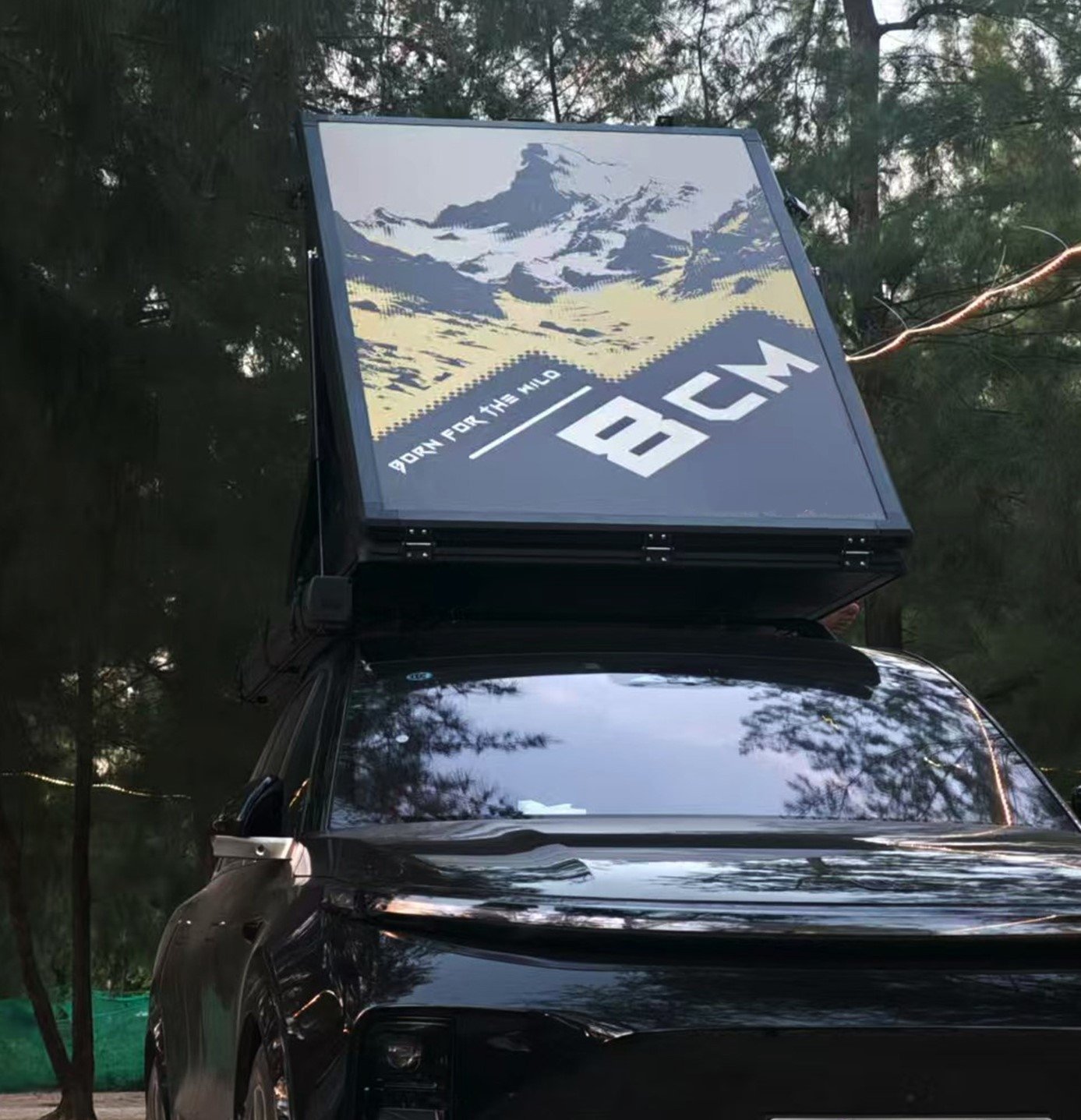
4. Why Lightweight Matters for Daily Driving
Reducing rooftop tent weight provides several benefits.
4.1 Better vehicle compatibility
Many passenger vehicles and SUVs have relatively limited dynamic roof-load ratings.
Approximate market ranges can be around:
| Vehicle Type | Typical Dynamic Roof Load |
|---|---|
| Small cars | 50–70 kg |
| Compact SUVs | 75–100 kg |
| Sedans | 75–100 kg |
| Large SUVs | 100–150 kg |
| Pickups | 100–150 kg |
These are only general ranges. The owner’s manual for the specific vehicle should always be treated as the final authority.
A lighter rooftop tent therefore opens the product to a much larger vehicle market.
5. Weight Affects the Vehicle’s Center of Gravity
A rooftop tent is mounted at one of the highest possible positions on the vehicle.
That means even a relatively small increase in mass can have a greater effect on vehicle dynamics than the same weight carried low in the cargo area.
A heavier rooftop tent can increase:
- vehicle center of gravity
- body roll during cornering
- suspension load
- braking demands
- crosswind sensitivity
- roof-rack stress
This becomes especially noticeable when the vehicle is used on:
- highways
- winding roads
- gravel roads
- corrugated tracks
- off-road trails
The objective isn’t simply to make the tent “light.”
The objective is to keep unnecessary mass off the roof.
6. Aerodynamics May Matter More Than Saving Another 5 kg
Here’s where rooftop tent engineering becomes interesting.
At highway speeds, aerodynamic performance can have a major impact on the vehicle.
A rooftop tent creates additional:
- frontal area
- aerodynamic drag
- turbulence
- wind noise
- roof loading
- fuel or energy consumption
A low-profile hard shell can therefore outperform a heavier but poorly shaped tent in real-world highway use.
Why?
Because aerodynamic drag increases approximately with the square of velocity:
Fᵈ = ½ρCᵈAV²
Where:
- Fd = aerodynamic drag
- ρ = air density
- Cd = drag coefficient
- A = frontal area
- V = vehicle speed
The important part is:
V²
If speed doubles, aerodynamic force theoretically increases by approximately four times.
This is why the aerodynamic design of a rooftop tent becomes increasingly important at highway speeds.
7. Why a Low-Profile Hard Shell Rooftop Tent Makes Sense
A well-designed hard shell rooftop tent should behave more like an aerodynamic roof accessory than a large box sitting on top of a vehicle.
Important design features include:
Low closed height
A lower closed profile reduces frontal area and helps the airflow pass smoothly over the tent.
Rounded leading edge
A rounded front edge can reduce abrupt flow separation compared with a sharp vertical face.
Sloped or wedge-shaped shell
A sloped shell helps guide airflow toward the rear.
Smooth exterior surface
A smooth shell eliminates fabric flutter and reduces turbulence compared with loose external materials.
Integrated mounting system
A well-designed mounting system can reduce unnecessary height and keep the tent closer to the vehicle roof.
This is one reason hard shell rooftop tents are attractive for daily driving and long-distance overlanding.
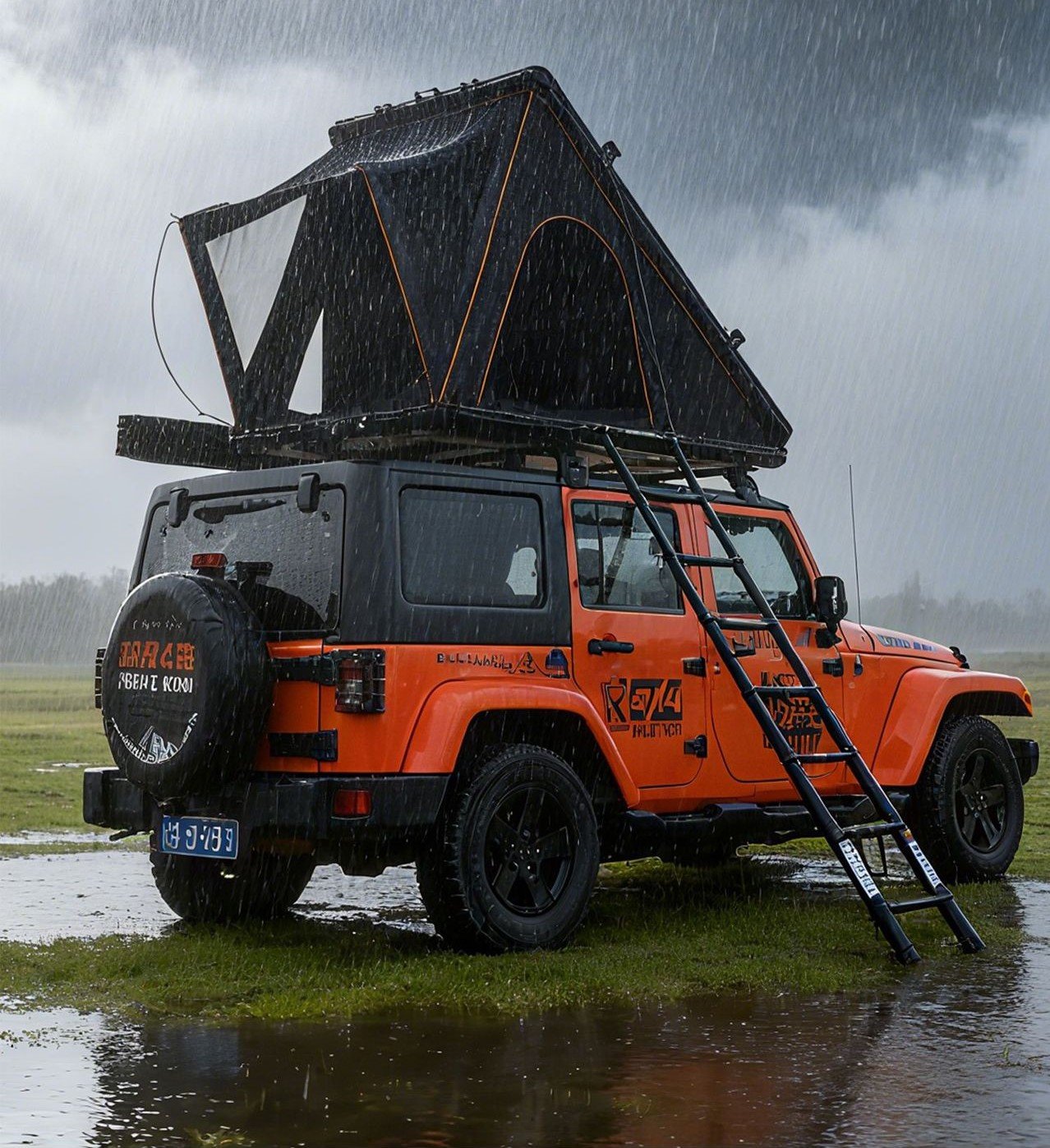
8. Wind Resistance: Don’t Confuse Weight With Wind Performance
One common misconception is:
“A heavier rooftop tent must be safer in strong wind.”
Not necessarily.
A heavier object has greater inertia, but rooftop tent wind resistance is primarily determined by:
- aerodynamic shape
- frontal area
- shell rigidity
- hinge strength
- mounting system
- roof rack
- fasteners
- load distribution
- connection between shell and base
A lightweight hard shell rooftop tent can be highly wind-resistant if these systems are properly engineered.
Conversely, a heavy rooftop tent with poor mounting hardware can still experience excessive uplift or vibration.
9. Understanding Real-World Wind Load
Wind force can be estimated from dynamic pressure.
A commonly used engineering relationship is:
q = 0.613V²
where:
- q = velocity pressure in N/m²
- V = wind velocity in m/s
This relationship is also reflected in ASCE wind-load calculations.
For example:
| Wind Speed | Approx. Dynamic Pressure |
|---|---|
| 50 km/h | ~118 Pa |
| 70 km/h | ~232 Pa |
| 90 km/h | ~383 Pa |
| 110 km/h | ~570 Pa |
| 130 km/h | ~797 Pa |
Notice what happens:
At 50 km/h → approximately 118 Pa
At 100 km/h → approximately 473 Pa
So doubling wind speed results in approximately four times the dynamic pressure.
And when driving, the tent does not only experience natural wind.
It experiences relative wind speed created by the combination of:
vehicle speed + headwind + crosswind + gusts
This is why highway aerodynamic design matters so much.
10. Real Gusts Are More Complicated Than a Single Wind-Speed Number
A rooftop tent manufacturer should not evaluate wind resistance based only on a single static wind speed.
Real outdoor conditions involve:
- sustained wind
- short-duration gusts
- changing wind direction
- crosswinds
- turbulence caused by trucks
- turbulence around buildings and trees
- vehicle-generated airflow
For example, a vehicle traveling at 100 km/h can experience a very different aerodynamic load when:
- driving into a 20 km/h headwind
- driving with a 20 km/h tailwind
- encountering a 40 km/h crosswind
Therefore, a meaningful rooftop tent wind-resistance program should consider load direction, duration and mounting configuration, not simply advertise a single “maximum wind speed.”
11. Why Mounting Hardware Can Be More Important Than the Shell
The strongest rooftop tent shell is useless if its mounting system is weak.
Wind forces eventually have to travel through a load path:
Shell → tent base → mounting rails → brackets → crossbars/platform → vehicle roof
Every connection is part of the system.
Potential failure points include:
- mounting bolts
- brackets
- rails
- crossbars
- roof rack feet
- roof rails
- vehicle mounting points
- shell hinges
This is why the correct engineering question isn’t:
“How strong is the tent?”
It should be:
“How strong is the entire rooftop tent system?”
12. Aluminum vs. Composite Hard Shell
Material selection also affects the weight/performance balance.
Aluminum
Advantages:
- high stiffness-to-weight ratio
- good structural rigidity
- relatively low weight
- good dimensional stability
- suitable for reinforced panel construction
Fiberglass / composite
Advantages:
- good surface finish
- good corrosion resistance
- excellent design flexibility
- potentially good impact performance depending on construction
But the material alone does not determine the final performance.
A thin aluminum shell with insufficient reinforcement may perform worse than a properly engineered composite shell.
The key is the complete structural design.
13. What About ASTM F3139?
This deserves a special section because the keyword appears online and is sometimes incorrectly associated with rooftop tents.
ASTM F3139 is not a rooftop tent wind-resistance standard.
ASTM’s official documentation identifies F3139-15 as a test method for analysis of tin-based solder alloys for minor and trace elements using ICP-AES.
For recreational camping tents, ASTM currently has standards including:
- ASTM F1934 — weighing backpacking/mountaineering tents
- ASTM F1935 — measuring tent headroom
- ASTM F2441 — labeling recreational camping tents and bivouac sacks
- ASTM F3431-25 — flammability requirements for recreational camping tents
ASTM F3431 specifically addresses controlled small-flame testing and flammability of tent materials; it is not a rooftop-tent wind-resistance certification.
Therefore, manufacturers should be careful about marketing language such as:
“ASTM F3139 Certified Windproof Rooftop Tent”
unless there is a completely different, independently verified basis for that claim.
For an international B2B brand, accurate technical claims are more valuable than impressive-sounding but incorrect certifications.
14. How Should Manufacturers Actually Test Rooftop Tent Wind Resistance?
Instead of relying on an incorrect certification claim, manufacturers can build a comprehensive internal or third-party test protocol.
A professional wind-resistance test can evaluate:
Shell deformation
Does the hard shell permanently deform under specified loading?
Hinge performance
Do hinges remain secure after repeated wind loading?
Mounting system
Do brackets, rails and fasteners remain securely attached?
Seal performance
Does deformation create water leakage?
Structural fatigue
Can the system withstand repeated wind cycles rather than a single short load?
Directional loading
Can the tent withstand:
- front wind
- rear wind
- side wind
- diagonal wind
Vehicle-mounted testing
A rooftop tent should ideally be tested in its actual mounting configuration rather than as an isolated shell.
This distinction is important for serious OEM rooftop tent manufacturers and outdoor brands.
15. What Is the Best Weight for a Daily-Driven Rooftop Tent?
If your primary use case is:
Monday–Friday daily driving + weekend camping + highway travel + occasional overlanding
then a practical design target is:
50–65 kg for a lightweight 2-person hard shell rooftop tent
This range offers a strong balance between:
- vehicle compatibility
- structural rigidity
- aerodynamic efficiency
- fuel economy
- roof-load margin
- easy installation
- daily driving performance
A 65–80 kg model can still be an excellent product, particularly for larger SUVs and pickups.
However, as the tent becomes heavier, manufacturers need to pay more attention to:
vehicle compatibility + rack capacity + mounting system + center of gravity + aerodynamic design.
16. The “Lightest Possible” Rooftop Tent Is Not Always the Best
This is an important distinction for both consumers and product developers.
Imagine two rooftop tents:
Tent A
- Weight: 48 kg
- Weak mounting system
- Thin shell
- Poor sealing
- High aerodynamic profile
Tent B
- Weight: 60 kg
- Reinforced aluminum structure
- Strong mounting rails
- Low-profile aerodynamic shell
- Better hinge system
- Better sealing
For a daily-driven overlanding vehicle, Tent B may be the better engineered product.
The goal should therefore be:
Optimize weight, don’t simply minimize weight.
This is a much more professional product-development philosophy.
17. A Better Way to Evaluate a Hard Shell Rooftop Tent
Instead of asking only:
“How many kilograms does it weigh?”
buyers should ask six questions:
1. What is the tent’s actual weight?
Does the listed weight include:
- mattress?
- mounting rails?
- ladder?
- brackets?
2. What is my vehicle’s dynamic roof load?
Always check the owner’s manual.
3. What does the complete system weigh?
Add:
tent + rack + brackets + accessories
4. How aerodynamic is the closed shell?
Look at:
- overall height
- frontal area
- front profile
- rear taper
- mounting height
5. How is wind resistance tested?
Ask whether the manufacturer has:
- wind tunnel testing
- CFD analysis
- structural testing
- vehicle testing
- third-party test reports
6. How is the mounting system engineered?
A strong tent requires a strong connection to the vehicle.
18. Final Verdict: What Makes the Best Rooftop Tent for Daily Driving?
The best rooftop tent for daily driving is not necessarily the lightest rooftop tent on the market.
It is the one that achieves the best balance between:
Weight + Aerodynamics + Structural Strength + Wind Resistance + Mounting Security + Vehicle Compatibility
For many daily-driven SUVs and 4x4s, a 50–65 kg lightweight hard shell rooftop tent can be an excellent target.
But the final decision should always start with the vehicle’s dynamic roof load.
A 55 kg tent on a vehicle with a 75 kg dynamic roof rating may leave very little margin once the rack and mounting hardware are included.
A 65 kg tent on a vehicle with a 120–150 kg dynamic roof rating may be perfectly reasonable.
In other words:
The right rooftop tent weight depends on the vehicle, not just the tent.
And for manufacturers, the most competitive product is not simply a “lightweight rooftop tent.”
It is a lightweight, low-profile, aerodynamic, structurally reinforced hard shell rooftop tent designed as a complete vehicle-mounted system.
That is what today’s daily-driving overlanders increasingly expect.
FAQ
How much does a hard shell rooftop tent usually weigh?
Most hard shell rooftop tents are approximately 50–85 kg, although lightweight models can be below 50 kg and larger expedition models can exceed 80–100 kg. Current market examples show hard shells from roughly 50 kg to more than 80 kg.
Is 60 kg too heavy for a rooftop tent?
Not necessarily. A 60 kg hard shell rooftop tent can be an excellent balance for many SUVs and 4x4s. However, you must add the weight of the roof rack, mounting brackets and other permanently mounted accessories before comparing the total with the vehicle’s dynamic roof-load rating.
What is the best rooftop tent weight for daily driving?
For a lightweight two-person hard shell rooftop tent, approximately 50–65 kg is a useful target range for many daily-driven vehicles. The ideal weight depends on the vehicle’s dynamic roof-load rating.
Does a heavier rooftop tent have better wind resistance?
Not necessarily. Wind resistance depends more on aerodynamic shape, shell rigidity, mounting hardware, structural design and load distribution than on weight alone.
Are hard shell rooftop tents more aerodynamic?
Generally, a low-profile hard shell can provide better aerodynamic performance than a soft-shell tent with exposed fabric when closed. The actual result depends on shell shape, height, frontal area and vehicle integration.
Does rooftop tent weight affect fuel economy?
Yes. A rooftop tent adds both mass and aerodynamic drag. At highway speeds, aerodynamic drag becomes particularly important because aerodynamic force increases approximately with the square of relative air speed.
Is ASTM F3139 a rooftop tent wind-resistance certification?
No. ASTM F3139 is officially a test method for analysis of tin-based solder alloys and is not a rooftop tent wind-resistance standard.
What should I check before buying a rooftop tent?
Check:
- Vehicle dynamic roof load
- Tent weight
- Roof rack/crossbar weight
- Mounting hardware
- Complete roof-system weight
- Tent closed height
- Aerodynamic design
- Wind-resistance testing
- Structural materials
- Manufacturer installation requirements